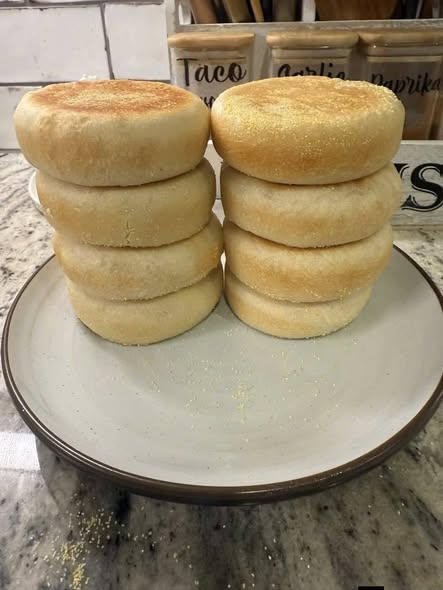
Here is a very detailed English muffin recipe that makes classic soft, chewy muffins with the characteristic nooks and crannies.
English Muffins
Yield: 12 large English muffins
Ingredients
For the dough:
4 cups (500 g) bread flour
1 cup (240 ml) whole milk
1 cup (240 ml) warm water
2 tablespoons sugar
2¼ teaspoons active dry yeast (1 packet)
1½ teaspoons salt
3 tablespoons unsalted butter, softened
For dusting:
½ cup cornmeal
2 tablespoons semolina flour (optional)
Instructions
Step 1: Activate the Yeast
Pour the warm water into a large mixing bowl. The water should feel warm but not hot, approximately 105°F to 110°F (40°C to 43°C). Add the sugar and stir until dissolved. Sprinkle the yeast over the surface and allow it to sit undisturbed for 5 to 10 minutes. The mixture should become foamy and bubbly. If the yeast does not foam, start again with fresh yeast.
Step 2: Warm the Milk
Heat the milk gently until lukewarm. Do not boil it. Add the milk to the yeast mixture and stir gently.
Step 3: Mix the Dough
Add about half of the flour to the liquid mixture and stir until a thick batter forms. Add the softened butter and salt. Gradually add the remaining flour, mixing continuously until a rough dough develops.
Step 4: Knead the Dough
Transfer the dough to a lightly floured work surface. Knead for 8 to 10 minutes by hand, or 5 to 6 minutes with a stand mixer fitted with a dough hook. The dough should become smooth, elastic, and slightly tacky but not sticky.
If the dough sticks excessively, add a tablespoon of flour at a time. Avoid adding too much flour, as a softer dough produces lighter muffins.
Step 5: First Rise
Place the dough in a lightly greased bowl. Turn it once so all sides are coated. Cover with plastic wrap or a damp towel.
Allow the dough to rise in a warm place for 1 to 1½ hours, or until doubled in size.
Step 6: Prepare the Work Surface
Mix the cornmeal and semolina flour together. Sprinkle a generous amount over a baking sheet and work surface. This coating prevents sticking and creates the traditional English muffin exterior.
Step 7: Shape the Muffins
Gently deflate the risen dough. Turn it onto the prepared surface.
Roll the dough to approximately ¾ inch (2 cm) thickness. Using a 3-inch round cutter, cut out circles. Gather scraps gently and reroll as needed.
Place the rounds on the cornmeal-coated baking sheet. Dust the tops lightly with additional cornmeal.
Step 8: Second Rise
Cover the muffins loosely with a clean kitchen towel.
Allow them to rise for 30 to 45 minutes. They should appear slightly puffed but not doubled.
Step 9: Prepare the Griddle
Heat a large cast-iron skillet, electric griddle, or heavy frying pan over low to medium-low heat.
The cooking surface should be approximately 300°F to 325°F (150°C to 165°C). Too much heat will burn the outside before the center cooks.
Lightly grease the surface if necessary.
Step 10: Cook the Muffins
Carefully place several muffins onto the hot griddle, leaving space between them.
Cook for approximately 7 to 10 minutes per side. Turn carefully with a spatula.
The muffins should develop a rich golden-brown crust. Internal temperature should reach approximately 200°F (93°C).
If the muffins brown too quickly, reduce the heat immediately.
Step 11: Optional Oven Finish
For extra insurance that the centers are fully cooked, place the griddled muffins on a baking sheet and bake at 350°F (175°C) for 5 to 8 minutes.
This step is especially useful for thicker muffins.
Step 12: Cool Completely
Transfer the cooked muffins to a wire rack. Allow them to cool for at least 30 minutes before opening.
Step 13: Open Correctly
For authentic texture, do not slice with a knife.
Instead, insert the tines of a fork around the circumference, then pull the muffin apart. This method creates the famous nooks and crannies that hold butter, jam, and other toppings.
Serving Suggestions
Serve toasted with butter.
Top with strawberry jam, raspberry preserves, or honey.
Use for breakfast sandwiches with eggs, cheese, and bacon.
Spread with peanut butter and sliced bananas.
Serve alongside soups and stews.
Make miniature pizzas using split English muffins.
Storage
Store cooled muffins in an airtight container at room temperature for up to 3 days.
For longer storage, freeze for up to 3 months. Place parchment paper between muffins before freezing to prevent sticking.
Troubleshooting Guide
Problem: Muffins are dense.
Possible causes:
Insufficient kneading.
Not enough rising time.
Too much flour added during mixing.
Problem: Muffins are burned outside but raw inside.
Possible causes:
Griddle temperature too high.
Muffins shaped too thick.
Cooking time too short.
Problem: Muffins do not rise well.
Possible causes:
Inactive yeast.
Cold rising environment.
Expired yeast.
Problem: Muffins are dry.
Possible causes:
Excess flour.
Overcooking.
Insufficient moisture in dough.
Professional Tips
Bread flour creates a chewier texture than all-purpose flour.
A long, slow rise in the refrigerator overnight develops deeper flavor. After the first rise, refrigerate the dough for 8 to 12 hours, then continue shaping and cooking the next day.
Weighing ingredients with a kitchen scale provides more consistent results than measuring cups.
Keep the griddle temperature low. English muffins require patience and gentle cooking.
Allow complete cooling before splitting and toasting to preserve the interior texture.
The best English muffins have a crisp golden exterior, a soft chewy crumb, and numerous irregular holes throughout the interior, making them perfect for holding melted butter and spreads.
